Tell You What: My Blog
Aug. 25, 2023
By Rob Shapard
Growing up in middle Georgia, Gordon Johnston realized early on that he was a bit of a “wild child.”
Not in the sense of being a rule-breaking, ruckus-raising troublemaking kid.
But in his passion for getting outdoors whenever possible, to explore the woods and creeks and find a piece of natural wildness not far from his backyard.
Johnston later worked his way through degrees from Shorter College and the University of Georgia, culminating in a doctorate in American literature from UGA. He started teaching at Mercer University in Macon, Ga., in 1996 and now is a full professor of creative writing and English literature.
But his inner wild child lives on; it shapes Johnston’s writing and teaching and sustains his connection to natural environments, such as the Ocmulgee River and other Georgia streams.
“I’ve always been really interested in creeks and rivers, and these liminal places where you’re in a wild place, but you’re not far from humankind,” Johnston told me. “Everywhere I’ve lived, I’ve found a place like that, where I felt fairly at home.”
Home on the Water
So, what does it take to be at home paddling a river? Learning the technical skills of canoeing and/or kayaking, for one; and learning the river through experiencing it over time – its shifting levels and currents, its flows over and around the rocks and earth, and many other aspects of the river’s nature. It is wise to come to the river with respect, humility, and awareness.
Johnston started on that path of knowledge in college, learning whitewater canoeing and paddling several Georgia rivers.
When he moved to Macon, he bought a canoe and took to the Ocmulgee, which flows from about forty miles north of Macon, down through the city, and then another two hundred miles or so to south Georgia near Lumber City. The Ocmulgee joins with the Oconee there to form the Altamaha River.
It took him a while, but Johnston now has paddled the full lengths of both the Ocmulgee and Oconee, and the Altamaha all the way to the coast. He also has paddled the entire Flint and Nottely rivers and stretches of several others, and throughout the Okefenokee Swamp.
In his new book, Seven Islands of the Ocmulgee: River Stories, published this year by Mercer University Press, Johnston draws on this hard-earned river knowledge, along with his historical research, deep knowledge of literature, and many years of getting very good at writing.
This book appeared on my radar when I was writing about the current proposal for a new national park and preserve to include the Ocmulgee Mounds and the river between Macon and Hawkinsville (see my piece on the proposal). Johnston also has published several collections of poetry and co-authored a non-fiction guide to the Ocmulgee Mounds.
I read the stories in Seven Islands first to take the fascinating trips they offer, and a second time to tune in more to the deeper stuff – the multiple insights and questions that the stories carry.
The stories in part explore how a river is never just one thing to people.
We can find healing power in the river, as well as its power to injure. The water can lessen our stress or ramp it way up, help us calm down or scare the heck out of us; it can be creative or destructive; an arena of sinning or a means of washing away sins in hopes of spiritual renewal.
People also find a sense of timelessness or permanence in a river, even though a river in fact is changing constantly. “Can’t nobody step in the same river twice,” as the character Aunt Neeta proclaims in the sixth story.
One unchanging truth is that a river is always worth knowing.
Happenings Down at the River
The first story begins with a character and situation that are quite funny in some ways, and then the tone in the story shifts; the final story in the book offers an engaging account of a man stepping out of the daily grind and going to spend a few hours on the Ocmulgee.
That final character feels a strong connection to the river (he voices much of Johnston’s own perspective); and he makes for an interesting contrast with the first character in the book, who does not know the river at all and is just fine with that.
In the opening story, “The Only Place to Start From,” Peavey is a grocery manager who goes reluctantly to retrieve a shopping cart that someone has taken from his store and dropped into the river in Macon. Peavey is quite grumpy about this task, and poorly equipped to deal with the river, along with most other aspects of the natural environment.
As the narrator observes, “Peavey had nothing against nature, but he mostly stayed out of it.”
The extent of Peavey’s preparation is to grab a pair of rubber boots from his store – sounds reasonable, but the problem is that these are the old boots the local fire department left in the store as receptacles for cash donations to the United Way. Nevertheless, Peavey dumps out the boots’ contents and wears them to wade into the river; he soon stumbles and one of the boots fills with water, dunking him in the river and aggravating him even further.
“Shorn of dignity, a complete catastrophe of retail management, he itched for somebody to fight or fire,” reports the narrator.
The story shifts when Peavey encounters a teenage boy who is using the shopping cart to trap a particular fish, as part of his quest for a life with purpose. At first, Peavey’s business at the river is so different from the boy’s business that they barely speak the same language. But Peavey, despite himself, becomes curious about what the boy is up to.
Johnston crafts vivid scenes and dialogue throughout the book; he offers a wide range of interesting characters, interactions with the Ocmulgee, and situations in which the characters have a lot at stake.
“Throughout the stories, people come back to the river; they sense a deeper history there, a deeper natural and ecological history, a human history that reaches back before their own. They feel small against the backdrop of that history, but it’s a pleasing smallness, a reassuring smallness rather than one that is intimidating. I hope that comes across in most of the stories.”
-Gordon Johnston in interview w/ Rob
Beginning with Peavey, Johnston also brings the funny from time to time.
For example, in “Skin Trade,” when the character Merlinda hopes to establish herself as an escort in Macon, she finds the outlook is promising. “Competition was so scarce that she had twice been sent flowers by clients,” the narrator notes. “The town was still full of churches, which her Atlanta colleague assured her was good for business.”
Going into the book, you might decide just to enjoy a bunch of good stories, and possibly find some new understandings of people and rivers.
And if you want to look more closely and tap into more of the insights and meanings, consider questions like:
What personal agendas do the different characters bring to the river?
Are they looking mainly to get out of the flow of ordinary life temporarily, or to experience some kind of lasting personal transformation?
How do events unfold in the stories, compared to the initial expectations of the characters?
What imagery and metaphors do you notice, and what ideas and emotions do they prompt?
In the final story, “Going to Water on Wise Creek,” the sole character relishes leaving the relentless noise and human maneuverings of daily life, and tuning his senses to the riverscape for a while. He is “going to water” to feel renewed; but he is not asking something of the river, so much as trying to meet the river on its terms.
A passage reads, “In coming to the river, he comes to be entirely subject to a place and to the processes, beauties, and dangers of its persisting, its going on in the oldest worldly way.
“He is choosing the Ocmulgee’s sounds – shoal chuckles, the different sighs of breeze through pine, hickory, and sycamore trees, a rare heron croak, the ratcheting and keening of kingfishers and hawks – which never dominate his senses and which never diminish into the background.”
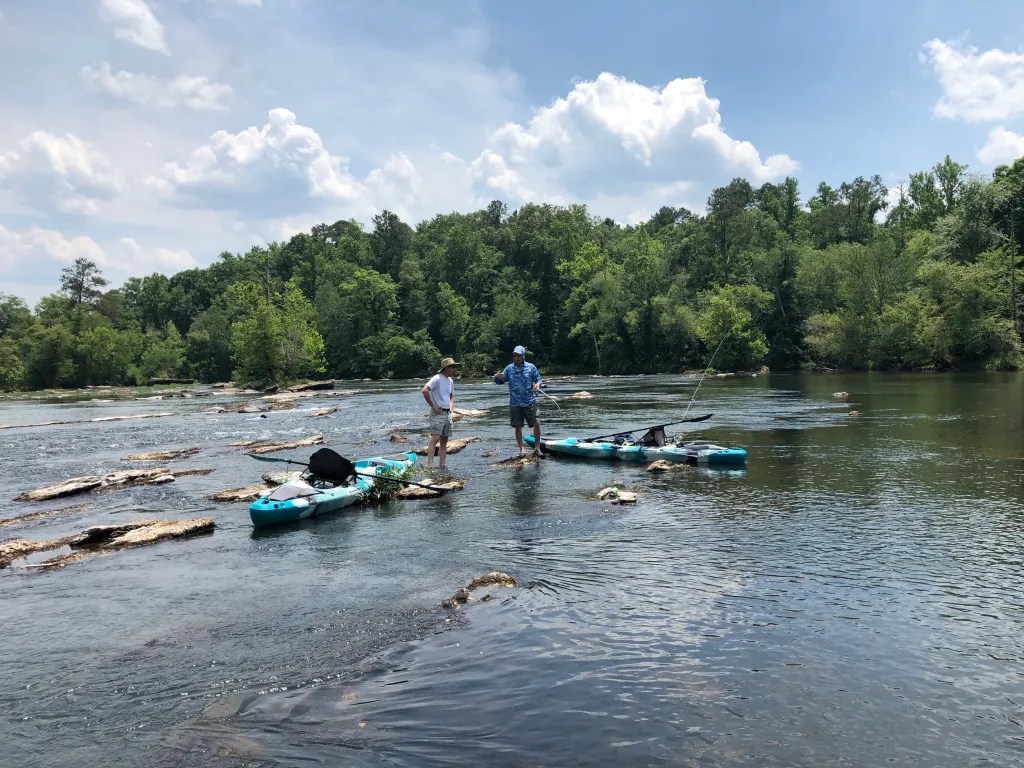
“Any time you put your keel to a current, you are taking a considerable chance. You’re giving yourself up to that flow, to whatever log jam you’re gonna run into, or whatever cottonmouth moccasin, or whoever might be hanging out under the bridge just downstream. Many of the excitements of a river are dangers.”
-Gordon Johnston in interview w/ Rob
Interview
Because I enjoyed these stories a great deal, I contacted Dr. Johnston and talked with him about the book, his approach to writing, and his love for rivers. I created an interview transcript (edited for clarity and length). Here are the first two questions and answers, and a link to the rest of the interview.
Rob Shapard (RS): Could you tell me more about where you grew up, and your personal story?
Gordon Johnston (GJ): I was born in Warner Robins, Georgia, which is below Macon. Warner Robins was an Air Force town built around Robins Air Force base. My father was not in the Air Force, but he did electronics-engineering work for the Air Force.
I thought that was a southern place when I was a kid. Later in my life, we moved to McDuffie County, around the time I was thirteen. I went to high school in Thomson, Georgia, and discovered that was the real southern place.
In Warner Robins, I had gone to middle school with kids who lived all over the world – Air Force kids who had lived in Guam, in Germany, and were pretty cosmopolitan.
Then we moved over to McDuffie County. That’s a fairly rural area, and I spent a lot of my time on Brier Creek and fishing small creeks and farm ponds, that sort of thing. I instantly became a sort of wild child out there.
I lived there ‘til I graduated high school in ’85 and went off to Shorter College, then to the University of Georgia; I have a PhD in American literature from Georgia. I did journalistic work, daily news reporting, to put myself through college. I also did some of that in grad school, until I started teaching.
I’ve always been really interested in creeks and rivers, and these liminal places where you’re in a wild place, but you’re not far from humankind. Everywhere I’ve lived, I’ve found a place like that, where I felt fairly at home.
I took a job here in Macon in 1996. When I was a kid in Warner Robins, you had to come to Macon to do any sort of shopping, really, so, I knew the Ocmulgee from then, and I knew downtown Macon from then.
One of the first things I did was go back to Ocmulgee Mounds. I had gone there as an elementary school kid on field trips; I think my first trip there was in the third grade.
I couldn’t wait to get back out there. It was as if time had not passed. It really felt like the same place. And I’ve been going to those woods and wetlands for close to three decades now.
I learned whitewater canoeing in college. I canoed on Amicalola Creek up in north Georgia, the Etowah, Talking Rock Creek – a number of different streams.
When I moved back to Macon, I bought a used Mohawk canoe, and I got busy on the river. I’ve paddled all the Ocmulgee and the Altamaha now, and all the Oconee down to the Altamaha and to the coast. So, I’m a river person in that way.

RS: Why do you think you became a “wild child”? Why did it feel like home to be outdoors?
GJ: Some of the wildness might have had to do with my reading. From the time I could read, I devoured books. I was a big Tolkien fan; I read and re-read The Lord of the Rings. I read a lot of C.S. Lewis – The Screwtape Letters, The Chronicles of Narnia. And I was sort of a history buff about World War Two. I read a lot of fighter pilots’ autobiographies.
The reading that I most gravitated to offered wild settings. Tolkien – his world-building is really botanically and ecologically detailed. He imagines these specific types of trees, flowers, minerals, metals, and animals that he populates Middle Earth with. I think some of my affinity for the natural world might have come from Tolkien.
And my father, he’d take me fishing, and my grandfather, who lived in Rock Hill, South Carolina, took me rabbit hunting. I’ve never been a terribly serious hunter. But I used to enjoy squirrel hunting with that grandfather. He was a remarkably good shot with a .22.
Both my father and grandfather felt most at home on creek banks and in the woods; they clearly got a sense of pleasure from it. It was a break, a release from work.
I intuited some of that from them. I was hardwired to enjoy the outdoors. I like animals a lot. And I have always loved to find a creek and just follow it, from the time I was a young kid. My family would go to the mountains on vacations – the area around Clayton, Georgia. I spent a good bit of time on the Chattooga River, the first mountain river I’d ever seen. That was the first time I ever conceived of getting in a boat and going down a river, when I was a kid watching canoers on the Chattooga.
Read the rest of the interview with Johnston’s thoughts on the Ocmulgee stories, rivers, and how he tunes into his characters when writing.
Seven Trails to Learning More
1. “Mercer professor finds peace and poetry on the river” (video).
2. Ocmulgee info from the Georgia River Network (link).
3. Ocmulgee River Water Trail (detailed map).
4. Ocmulgee River User’s Guide (book).
5. Fresh Air Bar-B-Que in Jackson and Macon (link).
(Why? Because every paddler needs their protein… And because I’ve been eating Fresh Air for nearly 50 years and want to give them a shout-out!)
6. Ocmulgee Mounds Association (link).
7. Ocmulgee National Monument: A Brief History with Field Notes (book).
 Taproots Journal
Leave a comment